ARTIFICIAL INTELLIGENCE INSTITUTE
PRIVATE PHILANTHROPIC BRIEFING
Prepared for Invited Leaders
FOURTH GRADE VILLAGE PROMISE
America's Behavioral Infrastructure Before AI becomes a habit, every child should learn how to remain the thinker.
Cognitive Offloading to Cognitive Amplification.
Every user. Every age. Every profession.
A National Philanthropic Initiative of Family First Foundation.
Delivered by the Artificial Intelligence Institute

THE EARLY SIGNAL
WHY THIS MOMENT MATTERS
WE SAW THE BEHAVIOR CHANGE BEFORE THE DEBATE CAUGHT UP.
Family First Foundation had something unusual: more than twenty-five years of trusted access to
educators, administrators, parents, and real school communities.
That access let us see artificial intelligence changing how children think as it happened, not in a report
months later, but in classrooms, every day. The real inflection point is fourth grade. That is when homework in this country stops being supervised and starts being self-directed and AI is already sitting on the device in a child's hand when that happens.
Some students told us it started even earlier. In our classrooms, a handful of second- and third-graders
have said, on camera, that they were already reaching for AI before fourth grade even began. We take that
seriously, it's exactly why we believe fourth grade is a line worth drawing early, not a line we're
drawing too late.
The concern was never that students were using AI. It was how quickly some were beginning to offload
their thinking to it, asking for an answer instead of working toward one, and accepting output before
ever learning to question it.
That is the moment this stopped being an enrichment program and became a national mission.
AI HAS NO DRIVER'S EDUCATION.
We would never hand someone the keys to a car and send them onto the highway with no instruction. Yet an entire generation, and most of the adults around them, began using the most powerful technology on the planet with no shared training in how to think, question, verify, create, and remain accountable while using it.
This is Driver's Education for Artificial Intelligence.
5 CLASSES · 5 HOURS · A FOUNDATION FOR A LIFETIME OF AI USE
Students already have the keys. We teach them how to drive.
THIS IS ALREADY WORKING. WE ARE NOT ASKING YOU TO BELIEVE A THEORY.
Two years. Real classrooms. Grades 4 through 8. Executing now, not piloting.
The clearest proof isn't a number. It's what people do after they experience it:
- Districts that finished one semester came back and paid for a second.
- Students who completed the program came back for more.
- Teachers who sat in only to evaluate the student class stayed through every session, and then asked for a version built for adults.
That is not marketing. That is what people do when something works.
EVERYONE ELSE IS BUILDING THE CAR. WE ARE BUILDING DRIVER'S EDUCATION.
Models will change. Platforms will change. Interfaces will change. The human habits underneath them should not.
We have pioneered the behavioral science that reverses cognitive offloading, transforming AI from a shortcut into an amplifier of independent thought. The change is measurable, rapid, and travels from the fourth-grade classroom to the boardroom.
The hardest part of this work was never the technology. It was designing something a nine-year-old could actually absorb. Children this age don't yet reason well in abstractions, 'ethics,' 'plagiarism,' 'academic integrity' are just words to them. But they understand story, and they understand character.
That's why we built Cognitive Mirrors: a set of characters, each one a distinct thinking pattern a student recognizes in themselves, the disciplined thinker, the impulsive shortcut-seeker, the curious innovator. Watching those patterns play out in story is what lets a nine-year-old actually catch themselves mid-habit, in a way no rulebook or policy ever could. It took two years inside real classrooms to get this right, and it's the part of this work we're proudest of.
The same underlying science graduates upward without changing its core: character-driven for grades 4 through 8, direct and professional for grades 9 through 12, the workforce, and educators themselves. One behavioral science. It travels from a fourth-grade classroom to a boardroom.
THINK WITH AI. NEVER LET AI THINK FOR YOU.
THE HUMAN HABITS WE ARE BUILDING
OBSERVE → THINK → QUESTION → VERIFY → CREATE → REFLECT → TRANSFER
Human thinking must remain the operating system.
THIS ROOM AND OUR PUBLIC SITE SERVE TWO DIFFERENT PURPOSES.
This Room is where we talk with the small number of people who might help lead this nationally. Our public site is where we talk with school districts, because our first and clearest goal has always been simple: every K–12 student in this country trained on how to think with AI, before AI enters their classroom at all. That site is built to move quickly with superintendents and administrators, who need clear numbers, compliance answers, and deployment details in a language they already use every day.
Both doors lead to the same place. One is built to recruit the leadership. The other is built to deliver at scale once that leadership is in place.

FROM MISSION-CRITICAL AI TO THE FOURTH-GRADE CLASSROOM
For nearly three decades, Dr. Russell Knight has worked around the AI systems NASA depends on for missions where disciplined reasoning and verification are not optional.
He did not expect those same principles to become urgently relevant inside a fourth-grade classroom. But the bridge became clear: the habits that protect a nine-year-old's reasoning are the same habits that protect the judgment of a scientist, an engineer, a physician, or a leader using increasingly capable AI.
Technology changes. The stakes change.
The behavioral discipline does not.
VERIFICATION IS NOT A FEATURE. IT IS A HABIT.
WHY FOURTH GRADE?
Fourth grade is the inflection point, the age when homework in America stops being supervised and starts being self-directed. AI is already present on the devices children carry when that shift happens. This is where the habit begins. And a habit, once automatic, is far harder to unlearn than it ever was to prevent.
Fourth grade is the baseline, not the ceiling. Our current work already reaches through eighth grade, and beyond.
BUILD THE HABIT BEFORE DEPENDENCE BECOMES THE HABIT.
BUILT IN SCHOOLS. REFINED OVER TWO YEARS.
5 classes
This is not a proposal in development.
- Two years of real-world deployment
- Student and educator experience
- A behavioral framework designed around thinking, verification, authorship, judgment, and responsible AI use
The Artificial Intelligence Institute has spent two years building, deploying, and refining responsible-AI education in real school environments.
5 hours of guided learning
20+ school sites
THE FOURTH GRADE VILLAGE PROMISE
America should make a simple promise to every child: before artificial intelligence becomes an everyday academic partner, every child should have the opportunity to learn how to think first, verify what AI tells them, protect their original thought, exercise human judgment, and remain accountable for their decisions.
That opportunity should not depend on ZIP code, family income, or whether a child's school happens to have the resources to provide it.
That is the Fourth Grade Village Promise.
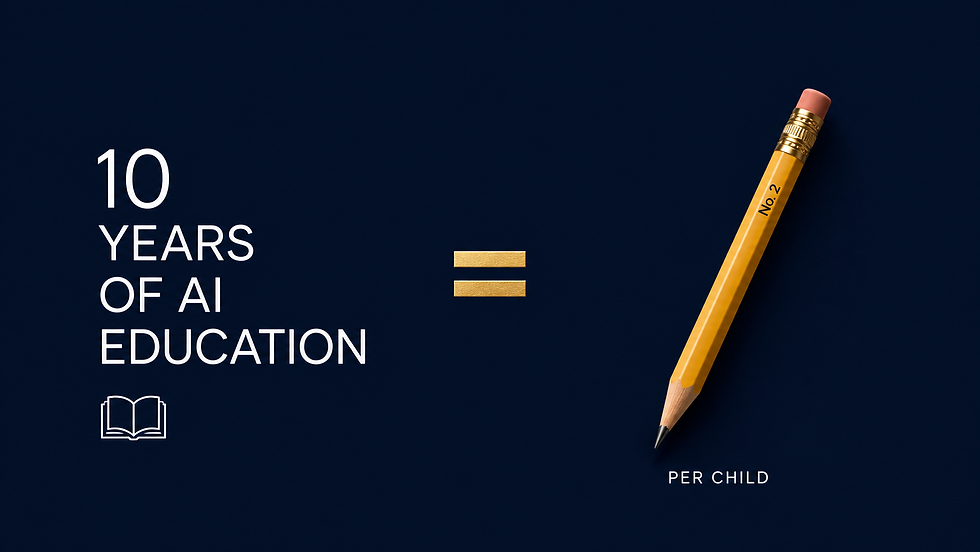
LESS THAN THE COST OF A PENCIL. FOR A GENERATION
$40 million. The entire cost, ten years, every K-12 student in America.
A fully developed educator version included.
Spread across 54 million children for ten years, that’s less than a pencil. Not a school year. The whole decade, PER CHILD, costs less than what’s sitting in a junk drawer right now.
Every month without a steward at this table is a cohort of fourth to twelfth graders we didn’t reach in time. There’s no version of this where waiting is the cheaper choice.

This seat is open.
AN INVITATION TO HELP BUILD THE VILLAGE
We built the part we know how to build.
Over the past two years, our educators, scientists, and nonprofit leadership have worked directly with schools and children to develop, deploy, and refine an approach to responsible AI use centered on one principle: human thinking must remain the operating system.
The next challenge is different.
Making the Fourth Grade Village Promise available nationally will require more than one organization. It will take philanthropy, education, research, technology, community leadership, and institutional partners working around a shared national purpose.
We are not simply asking for a grant.
We are seeking one or two Founding Stewards who may be willing to help shape the initiative, strengthen its national strategy, and help assemble the coalition capable of bringing the Fourth Grade Village Promise to children across America.
BUILDING THE NATIONAL VILLAGE
FOUNDING STEWARD
National vision + catalytic leadership
RESPONSIBLE AI PARTNERS
Human agency + ethics
RESEARCH & UNIVERSITY PARTNERS
Independent evidence + validation
TECHNOLOGY PARTNERS
Infrastructure + scale
K–12 PHILANTHROPIC PARTNERS
District access + expansion
REGIONAL PARTNERS
Local implementation
BUILT BY EDUCATORS, SCIENTISTS,AND
NONPROFIT LEADERS

The chairs above this table are empty. Two seats still open for those with national reach.
Russell Knight, Ph.D
President & Co-Founder, AI Institute. 26+ years, NASA JPL.
Dr. Russell Knight is a pioneer in mission-critical artificial intelligence, the kind that cannot afford to be wrong. For more than twenty-six years at NASA's Jet Propulsion Laboratory, he built autonomous AI systems for environments where failure is not an option, including deep-space navigation across a 302-million-mile journey. His work is documented in peer-reviewed publications and patents and has been recognized with NASA awards. No one else has taken that discipline, verification, disciplined reasoning, human accountability under real stakes, and translated it into how a nine-year-old learns to think alongside AI. That is the gap nobody else has closed. Dr. Knight closed it.
Dr. Knight is available to walk a Founding Steward through the science directly, the same discipline that guided a spacecraft to Mars, now guiding a generation of students.
NASA/JPL granted him special written permission to co foun the Institute. He didn't leave to do this. They made a room for both.

Co-Founder & Executive Director, AI Institute. Founder, Family First Foundation (25 years).
Richard Awni
Richard Awni spent twenty-five years earning trust in Los Angeles communities the slow way, one family, one school, one relationship at a time, without salary, because he believed it was the right thing to do. That work put him in the room when students first started showing up dependent on AI in ways no curriculum had prepared them for. He didn't set out to build a national movement. He found a national problem and recognized it was bigger than any one organization could carry alone. That recognition, and the trust it took twenty-five years to earn, is what makes this initiative real instead of theoretical.

Brian Taylor
Princeton All-American, captain and leading scorer of the 1971 U.S. Pan-American Games basketball team, ten professional seasons in the ABA and NBA, two-time ABA All-Star. Helped grow the Inner City Education Foundation from one founding school into a network of fifteen Los Angeles charter schools. Now applies the same systems-building instinct to the question of what schools should build before unhealthy AI habits take hold.
VP, Strategic Alliances and National Development, AI Institute.
Three leaders, decades of shared trust, and a unified mission to reach every fourth grader in the country. Now seeking Founding Stewards to help scale this national village.
INSTITUTIONAL BACKBONE

Lea Ubas
Teacher, President Advisory Board, Artificial Intelligence Institute, President, Family First Foundation, Commissioner, City of Glendale.
Lea built her governance career one board at a time , PTA unit president, then VP, now Executive President overseeing 24 School Boards: Glendale to Pomona Council PTA District 1. As a City of Glendale Commissioner, she sits on the Community Development Block Grant Commission, directly overseeing $3.4 million in federal funds every year. That’s not advisory input from the sidelines, it’s hands-on fiduciary oversight of a real federal budget, the same rigor a Founding Steward should expect applied to every dollar entrusted to this initiative.
Governance & Financial Oversight
HELP BUILD THE VILLAGE
We would value 20 minutes to show you what has already been built and discuss what the national village around these children could become.
If you believed every fourth grader in America deserved this before AI became part of everyday life, how would you help us build the village around them?